Continental Scientific Drilling Division Research Support Grants
CSD Research Support Grants
The Continental Scientific Drilling (CSD) Division of the Geological Society of America offers a grant-making program designed specifically to support early career scientists conducting research in areas that touch the CSD mission (scientific drilling, coring, subsurface investigation, etc.). The Division aims to provide bridge support for post-doctoral scholars and pre-tenure faculty at institutions of higher education in the USA to bolster scholarship and expand opportunities in an otherwise challenging federal funding ecosystem. This program may be renewed in future years depending on circumstances to be evaluated annually.
The Division will offer one or more Research Support Grants in 2026. Each grant will be valued at $8,000. Grants will be awarded competitively through an application process. Funds are reserved for research activities and may include costs associated with: fieldwork-related travel, fieldwork permitting, laboratory-related travel, laboratory analyses, student/technician salary support, field or lab consumables/supplies, conference/workshop travel, or similar. Applications will be evaluated by the CSD Awards Committee to make a recommendation to the Management Board, who will make final decisions on awards.
Awardees will be required to assist in the development of digital media (e.g., a LinkedIn post) around the impact of the grant on their research program. Awardees are encouraged to present their research at GSA Connects in a CSD-sponsored session. Awardees will be recognized at the Division business meeting at GSA Connects.
Eligibility:
-
Post doctoral scholar or pre-tenure faculty in geoscience, geology, geophysics, earth science (or closely allied discipline) in U.S.-based higher education
-
Member of the Geological Society of America
-
Member of the Continental Scientific Drilling Division
-
Demonstration of need
How to Apply:
-
Applications should send the following as a single pdf document to michael.mcglue@uky.edu:
-
Name, Address, Current Position, Contact Information
-
Research Proposal, with special emphasis on relevance and benefit of the proposed work to the CSD community (1 page max, single spaced, 12-pt font)
-
Statement of Need, including the identification and limitations of existing funding (1 page max, single spaced, 12-pt font)
-
Budget
-
Budget Justification
-
NSF-style Biographical Sketch
-
Letter of endorsement from department chair, affirming need
Applications are due Friday, July 10, 2026.
Awardees for 2025
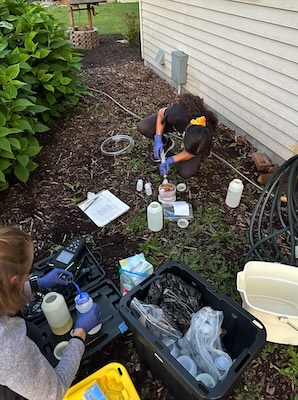
Athena Nghiem, University of Wisconsin - Madison
In the group of Assistant Professor Athena Nghiem in the Department of Geoscience at University of Wisconsin-Madison, we tackle the investigation of trace element cycling in the environment. Groundwater can be naturally-contaminated by trace elements that have a large impact on human health. In our research project led by Savannah Finley, we are investigating molybdenum contamination in groundwater. Molybdenum is an essential element at low concentration but toxic at high concentrations. With the funding from the GSA Continental Scientific Drilling Research Support Grant, we will be able to complete the picture by drilling of a new Quaternary core to resolve the sources of molybdenum contamination.
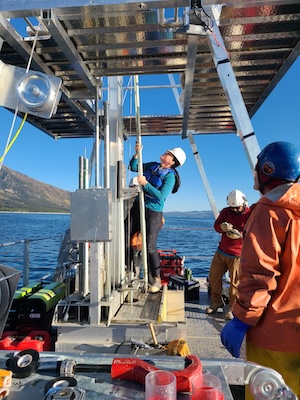
Giliane Rasbold, Western Kentucky University
Dr. Giliane Rasbold is an early-career Assistant Professor at Western Kentucky University and the coordinator of the Paleoecology and Paleolimnology Laboratory (Paleo² Lab). Her research examines how climate and ecosystems have changed over thousands of years in wetlands and lake systems across Brazil, Paraguay, Africa, and the United States. By studying microscopic fossils and charcoal preserved in lake sediments, she analyzes how past environments and fire activity responded to climate shifts. Her current project focuses on Jackson Lake in Grand Teton National Park, reconstructing 10,000 years of fire history and comparing it to modern fire patterns. This research improves understanding of how ecosystems respond to long-term climate change and disturbance.